For health-tech companies

Health tech marketing for categories buyers cannot name yet.

If nobody is searching for what you built, keyword research returns nothing and paid acquisition gets expensive fast. Organic still works — it just has to start from the problem instead of the product.

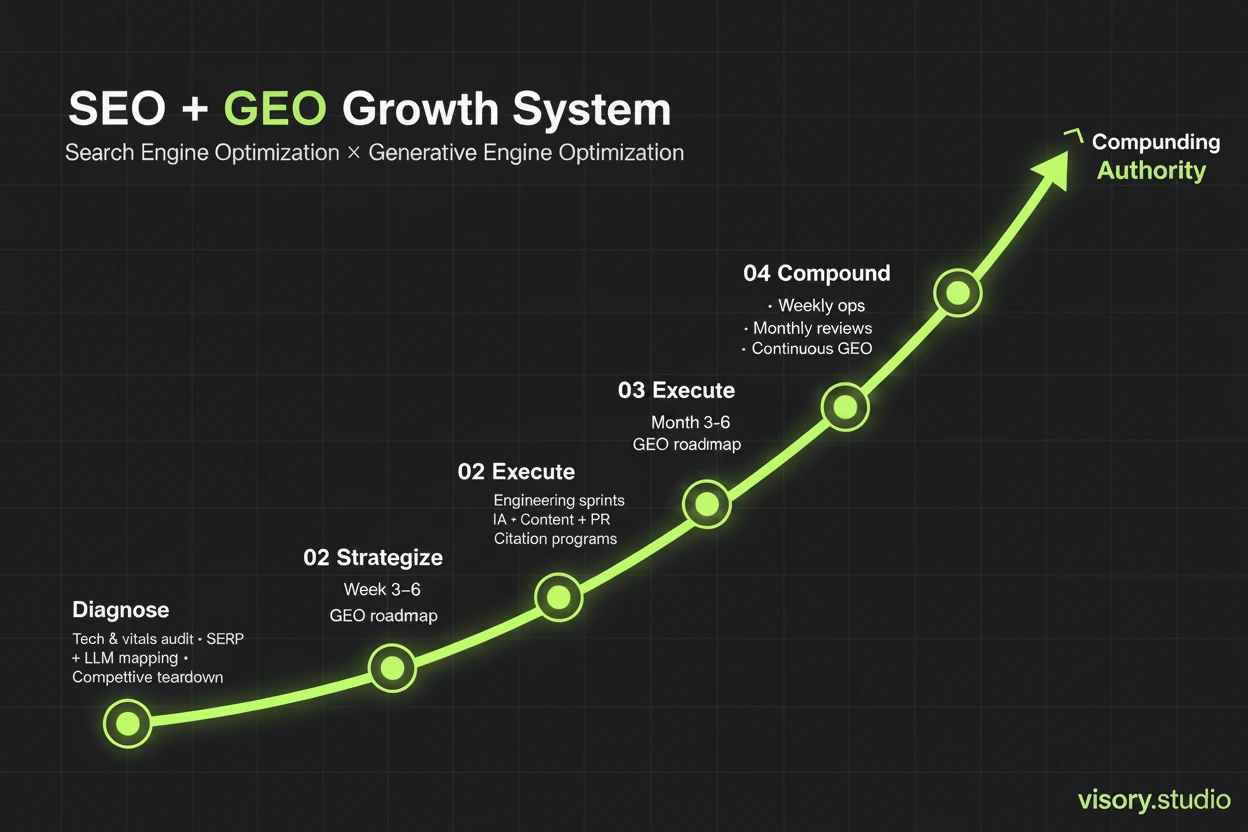
Visory Studio SEO and GEO growth system for health-tech marketing, shown as four rising phases
01  /  The problem

Health-tech companies routinely discover that their category has no search volume. The product solves a real problem, but the words the company uses for it are internal language that no buyer has ever typed.

The instinct is to conclude that SEO does not apply and to shift budget to paid and outbound. That is usually the wrong read. Your buyers are searching constantly — for the problem, the workaround they currently use, the compliance requirement forcing their hand, and the incumbent they are unhappy with. Those searches exist in volume. They just do not contain your product name.

There is a second complication. Health-tech sells to several audiences at once — clinicians, administrators, procurement, sometimes patients — who evaluate on different criteria and search in different language. One undifferentiated site trying to address all of them convinces none.

02  /  The case

Why health tech marketing breaks the standard playbook

C/01

Category creation breaks keyword research

Standard tooling reports what is already searched, so a genuinely new category returns nothing and looks like an opportunity that does not exist. The work is to map the problem space around the product — symptoms, workarounds, regulatory triggers, incumbent frustrations — and to build the pages that intercept buyers before they know a solution category exists.

C/02

Multiple audiences, incompatible vocabularies

A clinician searches clinically. An administrator searches operationally. Procurement searches about integration, security and contracts. The same product needs distinct paths for each, structured so search engines can tell them apart rather than averaging them into vagueness.

C/03

Compliance review throttles content velocity

Regulatory and clinical review is a real constraint on how fast marketing can ship, and it is the constraint most plans ignore. Building content that moves through review efficiently — claims isolated and sourced, reviewers looking at accuracy rather than style — matters more than any publishing target.

C/04

Trust signals matter more than in ordinary B2B

Buyers are assessing whether you will still exist in three years and whether you will survive their security review. Certifications, clinical evidence, integration documentation and named expertise are not marketing decoration in this category — they are the evaluation criteria, and they belong in the site architecture.

03  /  Scope

What we do.

W/01

Technical foundations

Performance, crawlability and structured data on marketing and product surfaces alike — engineered rather than patched.

W/02

Evidence and trust architecture

Certifications, clinical evidence, security documentation and integration detail structured as discoverable pages, not buried PDFs.

W/03

Problem-space content strategy

Mapping the searches around the problem, the workaround and the incumbent — then owning them before category language exists.

W/04

AI and GEO visibility

Being named when a buyer asks an assistant what tools exist for the problem you solve.

W/05

Audience-specific paths

Distinct routes for clinical, operational and procurement buyers, structured so search engines can tell them apart.

W/06

Pipeline measurement

Connecting organic to pipeline across long, multi-touch buying cycles rather than reporting sessions.

Four-phase roadmap from technical diagnosis to compounding authority across AI and search
04  /  Why Visory

Why Visory.

Health-tech is the specialism

We work with a small number of healthcare and health-technology companies at a time. The pattern recognition from that focus — what YMYL scrutiny actually rewards, how clinical review really behaves — is the product.

GEO is a first-class discipline

AI search visibility is engineered here, not offered as a workshop bolted onto an SEO retainer. Entity data, extractable content and citation strategy are built into the work from the first phase.

A consultancy, not agency churn

No account managers, no junior handoff, no roster of forty clients. You work directly with the operator doing the work, in 90-day cycles with no annual lock-in.

05  /  Questions

Frequently asked questions.

Does health tech marketing work when our category has no search volume?

Yes, but not through conventional keyword targeting. Demand exists around the problem even when it does not exist around your solution. The strategy is to own the problem space and the comparison space, then let category language grow into the position you have already built.

We sell B2B. Is organic search worth it?

In long-cycle B2B, organic tends to be undervalued precisely because attribution is hard. Buying committees run extensive unattributed research before they ever identify themselves. Being the source that answers their questions well shapes the shortlist you eventually appear on.

How does this differ from what an SEO agency would do?

Most agencies start from search volume, which is exactly the data that is missing for a new category. We start from the buying process and work back to the searches that surround it — and we build the technical and entity foundations that make generative engines able to describe you accurately.

Why does AI visibility matter for health-tech?

Because early-stage buyers now ask an assistant what tools exist for a problem, and the answer is a shortlist. Being absent from that shortlist removes you before evaluation starts. Getting into it depends on structured, corroborated, consistently described content — which is buildable.

Do you work with pre-revenue companies?

Occasionally, though usually it is early. Organic compounds over quarters, so it suits companies with the runway to let it work. Before product-market fit, the money is almost always better spent elsewhere.

Can you help with positioning as well as execution?

Positioning inevitably comes up, because search strategy forces the question of which problem you own. We will push on it where it blocks the work, but we are not a brand agency and will say so when that is what you actually need.

06  /  Related

Related services.

Healthcare search engine optimization company

Health systems, payers and healthcare vendors have a different problem from a single clinic: large legacy sites, multiple stakeholders, and buying cycles measured in quarters.

Healthcare search engine optimization company

SEO for health and wellness business

You are competing against aggregators with hundred-person content teams and marketplaces that rank for the searches your customers actually make. Specialist search strategy is how a smaller, better operator wins anyway.

SEO for health and wellness business

Medical search engine optimization agency

Most agencies treat a medical practice like any other local business, then discover halfway through that everything they publish needs clinical sign-off. We build for that from the first week.

Medical search engine optimization agency

Health tech SEO — Visory Studio

07  /  Start

Ready to be found first?

A 30-minute conversation about your organic growth, your AI visibility, and whether we are the right partner. No decks, no pitch — just diagnostics.

Availability · Q1 2026 Fewer than 8 clients at once Response within 24h