Health & wellness

SEO for health and wellness business owners who are tired of being invisible.

You are competing against aggregators with hundred-person content teams and marketplaces that rank for the searches your customers actually make. Specialist search strategy is how a smaller, better operator wins anyway.

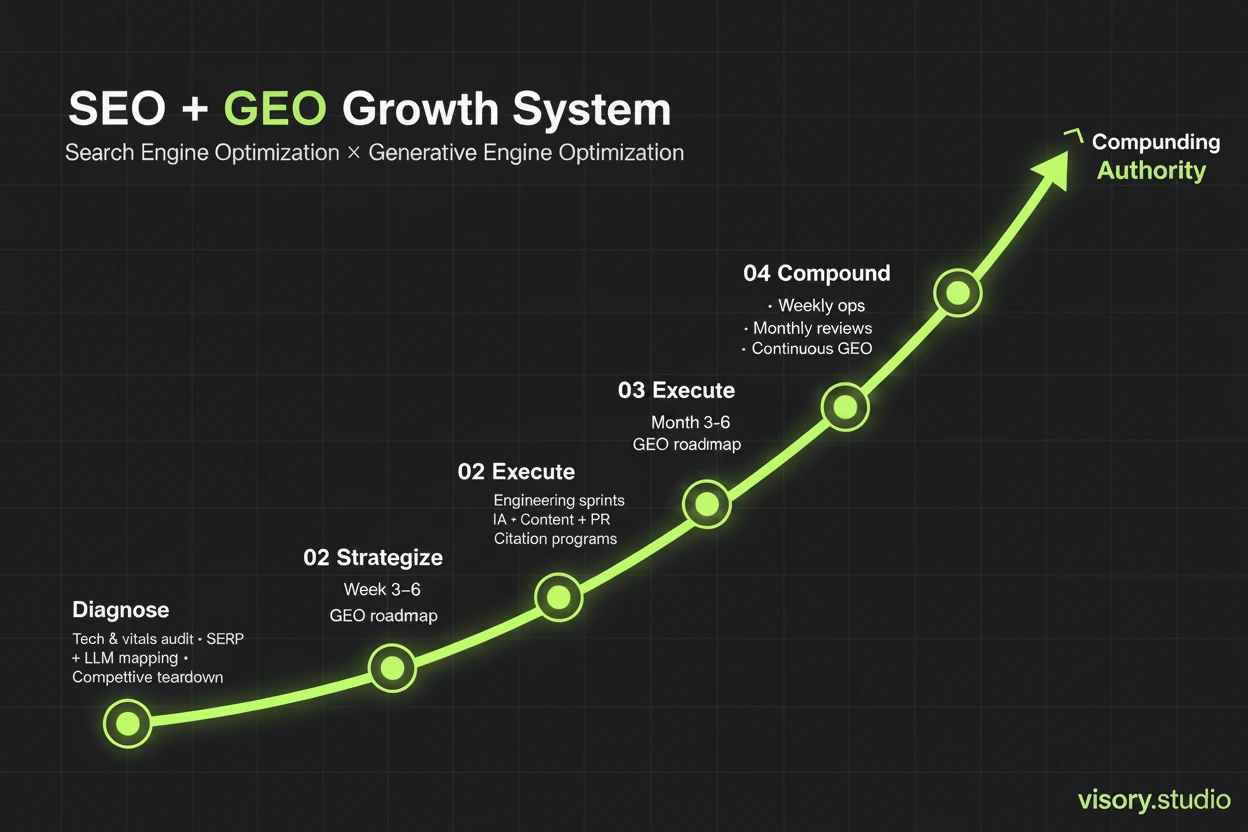
Visory Studio SEO and GEO growth system, four phases rising toward compounding authority
01  /  The problem

Health and wellness is one of the most contested categories in organic search. The queries your customers type — about sleep, nutrition, recovery, hormones, fitness, supplements, stress — are the same queries that publishers, marketplaces and venture-funded content farms have spent a decade optimising for.

Most wellness businesses respond by publishing more blog posts. That rarely works, because volume was never the constraint. The constraint is that Google treats health-adjacent content as higher risk, applies a stricter quality bar to it, and rewards sites that can demonstrate genuine expertise and a clean technical foundation.

And discovery has moved. A meaningful share of your customers now ask ChatGPT, Perplexity or Google's AI Overviews before they ever see a list of blue links. Being visible in those answers is a different engineering problem from ranking — and one almost nobody in wellness is solving deliberately.

02  /  The case

Why SEO for health and wellness business owners is its own discipline

C/01

YMYL scrutiny without medical resources

Wellness sits directly beside Your Money or Your Life territory. Content about supplements, diets, hormones or recovery gets held to a health standard by Google's quality systems — but wellness businesses rarely have a medical reviewer, a credentialed author roster, or the citation discipline that clinical publishers have. You inherit the scrutiny without inheriting the infrastructure.

C/02

Claim constraints your competitors ignore

Regulators police what you can say about outcomes. Your least scrupulous competitor will make claims you cannot legally make, and may rank while doing it. Sustainable strategy means winning on the searches where accurate, well-evidenced answers beat overstated ones — and building the topical authority that outlasts an enforcement cycle.

C/03

Aggregators own the head terms

For broad category queries, the first page is often marketplaces, directories and large publishers. Attacking those terms head-on is usually a waste of budget. The winnable ground is specific, intent-rich, and much closer to a purchase — and it requires an information architecture built around how people actually search rather than around your service menu.

C/04

Local and national pulling in opposite directions

Many wellness businesses serve a physical catchment and sell something shippable or remote. Those need different page systems, different schema and different measurement. Collapsing them into one site structure is why so many wellness sites rank for nothing in particular.

03  /  Scope

What we do.

W/01

Technical foundations

Crawl and index health, site speed, Core Web Vitals and the structural fixes that decide whether anything else you do can work.

W/02

E-E-A-T and author authority

Named authors with real qualifications, transparent sourcing, and the organisational signals that separate a credible wellness brand from a content farm.

W/03

Content strategy built on intent

Topic clusters organised around what buyers actually search, not around your service menu — with claim language that stays defensible.

W/04

AI and GEO visibility

Structured data, entity definitions and citation-worthy content so ChatGPT, Perplexity, Claude and Google AI Overviews describe you accurately.

W/05

Local search where it matters

For studios, clinics and physical locations: profile optimisation, citation consistency and location pages with genuine local substance.

W/06

Measurement that means something

Revenue, qualified enquiries and AI citation share — with rankings and impressions kept as diagnostics rather than goals.

Four-phase SEO and GEO roadmap applied to health and wellness business growth
04  /  Why Visory

Why Visory.

Health-tech is the specialism

We work with a small number of healthcare and health-technology companies at a time. The pattern recognition from that focus — what YMYL scrutiny actually rewards, how clinical review really behaves — is the product.

GEO is a first-class discipline

AI search visibility is engineered here, not offered as a workshop bolted onto an SEO retainer. Entity data, extractable content and citation strategy are built into the work from the first phase.

A consultancy, not agency churn

No account managers, no junior handoff, no roster of forty clients. You work directly with the operator doing the work, in 90-day cycles with no annual lock-in.

05  /  Questions

Frequently asked questions.

How is SEO for health and wellness business different from regular SEO?

The mechanics are the same; the quality bar is not. Health-adjacent content is assessed against stricter standards, which means author credentials, citations, review processes and factual precision carry far more weight than they would for, say, a software company. Technical execution that would be adequate elsewhere is often not enough here.

How long before we see results?

For a site with a sound technical base, meaningful movement usually appears in the second or third month, with compounding through months four to nine. Sites carrying indexation problems, thin content at scale or a history of aggressive tactics take longer, because the first phase is repair rather than growth.

Do we need to publish constantly?

No. Publishing cadence is the most over-prescribed advice in wellness marketing. A smaller number of genuinely authoritative pages, properly structured and internally linked, consistently outperforms a high-volume blog that dilutes topical focus and burns your team out.

Can you help us appear in ChatGPT and AI Overviews?

That is a core part of the work rather than an add-on. Generative engines pull from sources they can parse, trust and attribute. Being cited depends on structured data, clear entity definitions, extractable claims and third-party corroboration — all of which we build deliberately.

We sell supplements. Is that harder?

Yes, materially. Supplements attract both stricter search quality assessment and active regulatory attention. It is workable, but it demands conservative claim language, real evidence hygiene, and a content strategy that competes on trust rather than on promises.

Do you work with single-location studios?

Sometimes, though the economics work best when there is either a product line or multiple locations. For a single studio, local search fundamentals plus a well-structured site will usually get you most of the available upside without a full engagement.

06  /  Related

Related services.

Health tech marketing

If nobody is searching for what you built, keyword research returns nothing and paid acquisition gets expensive fast. Organic still works — it just has to start from the problem instead of the product.

Health tech marketing

SEO for mental health clinics

When you run multiple clinicians, several locations and a set of distinct programmes, search stops being a content problem and becomes an architecture problem.

SEO for mental health clinics

Healthcare search engine optimization company

Health systems, payers and healthcare vendors have a different problem from a single clinic: large legacy sites, multiple stakeholders, and buying cycles measured in quarters.

Healthcare search engine optimization company

Health tech SEO — Visory Studio

07  /  Start

Ready to be found first?

A 30-minute conversation about your organic growth, your AI visibility, and whether we are the right partner. No decks, no pitch — just diagnostics.

Availability · Q1 2026 Fewer than 8 clients at once Response within 24h