Group & multi-site

SEO for mental health clinics with more capacity than referrals.

When you run multiple clinicians, several locations and a set of distinct programmes, search stops being a content problem and becomes an architecture problem.

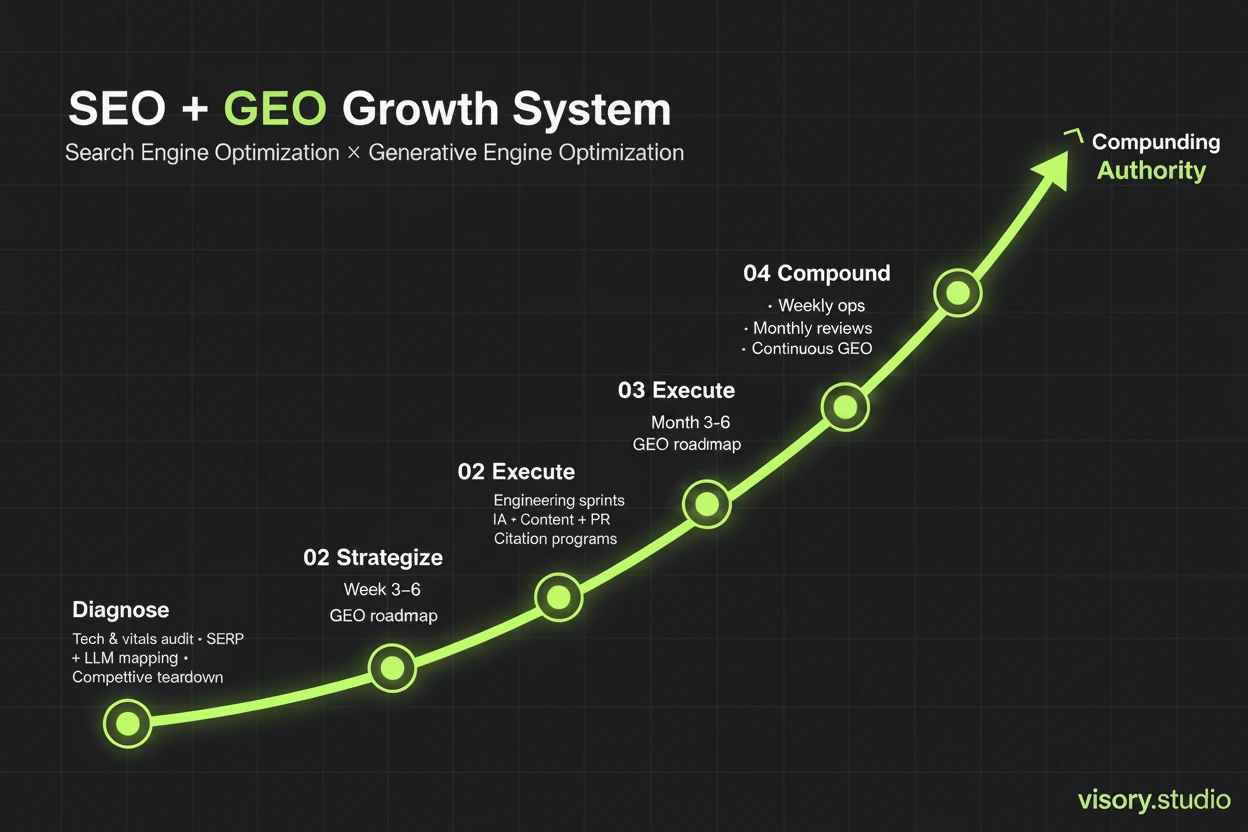
Four-phase SEO and GEO growth system diagram for mental health clinic engagements
01  /  The problem

A group practice has the opposite problem to a solo clinician. You are not short of expertise or services — you are short of a structure that lets search engines understand what you offer, where you offer it, and who delivers it.

The typical clinic site collapses this into a handful of pages: a services list, a team page, a contact form. That structure cannot rank for the combinations that actually drive intake, because those combinations are specific — a programme, in a location, for a population, often with an insurance qualifier attached.

Solving it properly means building page systems rather than pages: programme pages that stand on their own, location pages with genuine local signals, and clinician profiles that carry real credential data. Done well, this fills intake from search rather than from referral relationships you cannot scale.

02  /  The case

Why SEO for mental health clinics is an architecture problem

C/01

Multi-location search is its own discipline

Every site you operate needs distinct local signals: a real address, consistent citations, its own profile, its own page with content that is genuinely different from your other locations. Duplicating a template across five cities and swapping the place name is the single most common reason multi-site clinics fail to rank locally.

C/02

Service lines compete with each other

Intensive outpatient, partial hospitalisation, TMS, medication management, group programmes and standard outpatient therapy are different services bought by different people in different circumstances. When they share one page, that page ranks for nothing well. When they are separated properly, each becomes an entry point — but separation has to be done without creating thin or overlapping content.

C/03

Clinician profiles are authority infrastructure

In a YMYL category, a roster of licensed clinicians is one of the strongest expertise signals you have. Most clinic sites waste it on a grid of headshots. Profiles carrying licence type, credentials, specialisms, languages and populations served give search engines something concrete to evaluate — and give prospective clients a reason to choose you.

C/04

Compliance shapes measurement

Analytics on a healthcare site is not a neutral technical choice. Tracking that leaks identifiable information into advertising platforms creates genuine exposure, and standard marketing instrumentation frequently does exactly that. Measurement has to be designed with that constraint in mind, not retrofitted after a review.

03  /  Scope

What we do.

W/01

Technical foundations at scale

Crawl budget, indexation control, template performance and the architecture decisions that determine whether a large clinic site can rank at all.

W/02

Clinician profiles as authority infrastructure

Structured profiles carrying licence, credentials, specialisms, languages and populations served — the strongest E-E-A-T asset most clinics already have and waste.

W/03

Programme and service-line page systems

Distinct, substantive pages for each programme and level of care, built as repeatable templates that stay useful as you add more.

W/04

AI and GEO visibility

Consistent organisational entity data and extractable content so generative engines represent your programmes correctly.

W/05

Multi-location local search

Genuine local signals per site: profiles, citations, and location pages that are actually different from one another.

W/06

Intake-focused measurement

Tracking that connects search to completed intakes, designed to avoid transmitting identifiable information to third parties.

Growth curve showing diagnose, strategize, execute and compound phases for clinic visibility
04  /  Why Visory

Why Visory.

Health-tech is the specialism

We work with a small number of healthcare and health-technology companies at a time. The pattern recognition from that focus — what YMYL scrutiny actually rewards, how clinical review really behaves — is the product.

GEO is a first-class discipline

AI search visibility is engineered here, not offered as a workshop bolted onto an SEO retainer. Entity data, extractable content and citation strategy are built into the work from the first phase.

A consultancy, not agency churn

No account managers, no junior handoff, no roster of forty clients. You work directly with the operator doing the work, in 90-day cycles with no annual lock-in.

05  /  Questions

Frequently asked questions.

How is SEO for mental health clinics different from a solo practice?

Scale changes the problem. A solo clinician needs a few excellent pages. A clinic needs systems — repeatable page templates for programmes, locations and clinicians that stay distinct and useful as you add more of them. The technical and architectural work is a much larger share of the engagement.

We have five locations. Do we need five sites?

Almost never. One domain with a well-built location structure concentrates authority instead of splitting it. Separate domains per location is a pattern that occasionally makes sense for genuinely separate brands, and usually makes things worse.

Will more pages create thin content problems?

Only if the pages are generated rather than designed. The distinction is whether each page answers a question a real person has. A programme-in-a-city page with genuine local detail, real clinician links and specific admissions information is a good page. The same page with a place name swapped in is not.

How do you handle HIPAA and analytics?

By designing measurement to avoid transmitting identifiable information to third parties in the first place, and by being explicit about what each tool collects. We are not your compliance counsel, and we will tell you when something needs their review rather than guessing.

Can you work with our EHR or intake system?

We work around it. The goal is to get qualified people to the point of enquiry, and to instrument that handoff so you can see which searches produce actual intakes rather than form fills.

How do clinics appear in AI search results?

The same way they earn featured snippets, but with more emphasis on structure. Generative engines favour sources with clear entity definitions, consistent organisational data, credentialed authors and content that can be extracted cleanly. Clinics with well-built programme and clinician pages have a real advantage here.

06  /  Related

Related services.

SEO for mental health therapists

Referral directories rent you visibility and take it back the moment you stop paying. Your own site can earn it permanently — and it is a smaller job than most therapists assume.

SEO for mental health therapists

Medical search engine optimization agency

Most agencies treat a medical practice like any other local business, then discover halfway through that everything they publish needs clinical sign-off. We build for that from the first week.

Medical search engine optimization agency

Healthcare search engine optimization company

Health systems, payers and healthcare vendors have a different problem from a single clinic: large legacy sites, multiple stakeholders, and buying cycles measured in quarters.

Healthcare search engine optimization company

Health tech SEO — Visory Studio

07  /  Start

Ready to be found first?

A 30-minute conversation about your organic growth, your AI visibility, and whether we are the right partner. No decks, no pitch — just diagnostics.

Availability · Q1 2026 Fewer than 8 clients at once Response within 24h