Private practice

SEO for mental health therapists who want a full caseload, not another directory listing.

Referral directories rent you visibility and take it back the moment you stop paying. Your own site can earn it permanently — and it is a smaller job than most therapists assume.

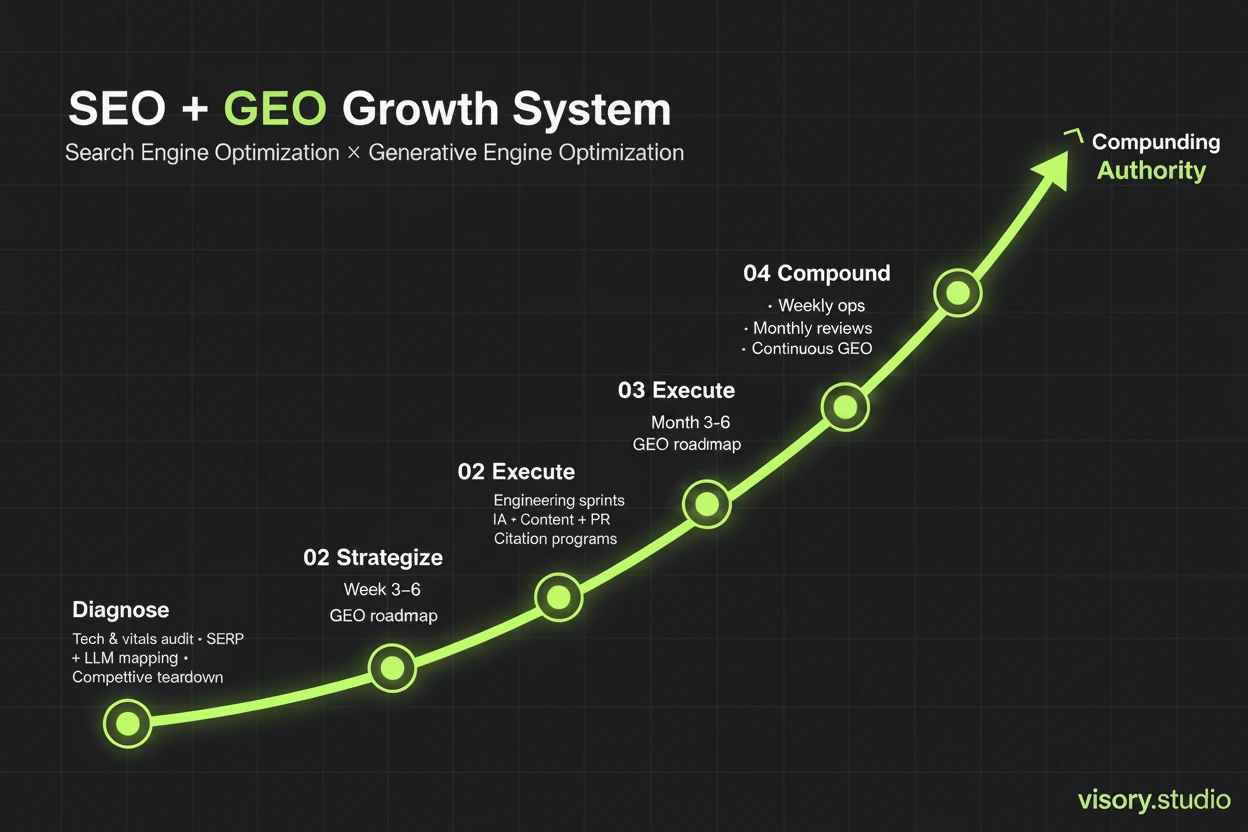
Diagram of the four-phase SEO and GEO growth system used for private therapy practices
01  /  The problem

Most therapists in private practice get clients from two places: professional referrals, and a paid directory profile. Both work. Neither is owned. When the directory changes its ranking logic or raises its rates, your caseload moves with it, and you have no recourse.

The alternative is a small, well-built site that ranks for the specific searches people make when they are ready to book — a modality in a city, a presenting problem, an insurance question. These searches have modest volume and very high intent. Competing for them is entirely achievable for a solo practitioner, because your competition is mostly other therapists who have never touched their website.

This is also a field where the usual marketing playbook does not apply. Professional ethics codes restrict soliciting client testimonials, which removes the single most common trust signal other local businesses lean on. That constraint shapes everything about how a therapy practice should build authority.

02  /  The case

Why SEO for mental health therapists works differently

C/01

You cannot use the usual proof

ACA and APA ethics codes place real limits on soliciting testimonials from current or former clients. Every generic local SEO guide tells you to gather reviews; for you that advice ranges from risky to prohibited. Authority has to be built from credentials, training, supervision, specialisms, writing and professional affiliation instead — which search engines can read perfectly well, if the site is structured to expose them.

C/02

Licensure is geographic, and search is not

You can only practise where you are licensed, and increasingly across state lines under compacts. A site that does not make its jurisdictional scope explicit either attracts enquiries you must decline, or fails to surface for the ones you can serve. Getting this right is a structural decision, not a footer disclaimer.

C/03

YMYL applies to you directly

Mental health content sits squarely inside Google's highest-scrutiny category. Pages about diagnoses, symptoms and treatment approaches are assessed against clinical standards. As a licensed clinician you are genuinely qualified to write them — but only if the site demonstrates who you are, what you are licensed to do, and where your expertise comes from.

C/04

Directories outrank you by default

Psychology Today and its equivalents have domain authority you will never match, and they will usually win broad terms like therapist plus a city name. The winnable searches are narrower and more specific: a modality, a population, a presenting concern, a language, an insurance panel. Those are where the ready-to-book clients are, and where directories are weakest.

03  /  Scope

What we do.

W/01

Technical foundations

A fast, crawlable, mobile-first site. Most therapy practice sites fail here first, and no amount of content compensates for it.

W/02

Credentials as authority signals

Licence type, training, supervision, specialisms and professional membership structured so both search engines and prospective clients can read them.

W/03

Content built around presenting concerns

Pages for the specific problems, modalities and populations you actually work with — the searches that produce enquiries rather than traffic.

W/04

AI and GEO visibility

Structured, well-attributed content so AI assistants name your practice when someone describes a problem you treat.

W/05

Local search for private practice

Map pack visibility, profile optimisation and location signals, handled within the bounds your ethics code allows.

W/06

Measurement without overreach

Enquiry volume and quality, tracked with analytics configured appropriately for a clinical context.

SEO and GEO phases from diagnosis through execution to compounding organic authority
04  /  Why Visory

Why Visory.

Health-tech is the specialism

We work with a small number of healthcare and health-technology companies at a time. The pattern recognition from that focus — what YMYL scrutiny actually rewards, how clinical review really behaves — is the product.

GEO is a first-class discipline

AI search visibility is engineered here, not offered as a workshop bolted onto an SEO retainer. Entity data, extractable content and citation strategy are built into the work from the first phase.

A consultancy, not agency churn

No account managers, no junior handoff, no roster of forty clients. You work directly with the operator doing the work, in 90-day cycles with no annual lock-in.

05  /  Questions

Frequently asked questions.

Is SEO for mental health therapists worth it for a solo practice?

Usually yes, because the bar is low and the intent is high. You are not competing with venture-funded content teams for these searches — you are competing with other clinicians whose sites are a single page with a contact form. A handful of well-built pages can fill a caseload.

How do I build trust online without testimonials?

Through everything that is not a testimonial: licence details, training and supervision history, specialist certifications, professional body membership, and your own writing about how you actually work. Search engines read these as expertise signals, and prospective clients read them as reassurance. It is a stronger foundation than reviews anyway.

Should I still pay for a directory profile?

Keep it while you build. Directories provide immediate flow, and organic search takes months to compound. The goal is not to cancel your profile tomorrow — it is to stop being dependent on it within a year.

What should I actually write about?

The questions people ask before they book, answered honestly: what a first session is like, how a modality works and who it suits, what you charge, whether you take a given insurance, how long people typically stay in therapy. Practical, specific and in your own voice.

Do I need to blog every week?

No. For most private practices, a small number of genuinely useful pages beats a weekly blog nobody reads. Consistency matters far less than specificity and accuracy in this niche.

Can therapists appear in ChatGPT or AI search results?

Yes, and it is becoming a real referral source. People increasingly describe a problem to an AI assistant and ask what kind of help exists. Practices with clear, well-structured, well-attributed content about specific presenting concerns are the ones getting named.

06  /  Related

Related services.

SEO for mental health clinics

When you run multiple clinicians, several locations and a set of distinct programmes, search stops being a content problem and becomes an architecture problem.

SEO for mental health clinics

Medical search engine optimization agency

Most agencies treat a medical practice like any other local business, then discover halfway through that everything they publish needs clinical sign-off. We build for that from the first week.

Medical search engine optimization agency

SEO for health and wellness business

You are competing against aggregators with hundred-person content teams and marketplaces that rank for the searches your customers actually make. Specialist search strategy is how a smaller, better operator wins anyway.

SEO for health and wellness business

Health tech SEO — Visory Studio

07  /  Start

Ready to be found first?

A 30-minute conversation about your organic growth, your AI visibility, and whether we are the right partner. No decks, no pitch — just diagnostics.

Availability · Q1 2026 Fewer than 8 clients at once Response within 24h